Curriculum
- 2 Sections
- 1 Lesson
- 10 Hours
Expand all sectionsCollapse all sections
- What is the Model Context Protocol1 Item> ## Documentation Index > Fetch the complete documentation index at: https://modelcontextprotocol.io/llms.txt > Use this file to discover all available pages before exploring further. # What is the Model Context Protocol (MCP)? MCP (Model Context Protocol) is an open-source standard for connecting AI applications to external systems. Using MCP, AI applications like Claude or ChatGPT can connect to data sources (e.g. local files, databases), tools (e.g. search engines, calculators) and workflows (e.g. specialized prompts)—enabling them to access key information and perform tasks. Think of MCP like a USB-C port for AI applications. Just as USB-C provides a standardized way to connect electronic devices, MCP provides a standardized way to connect AI applications to external systems.
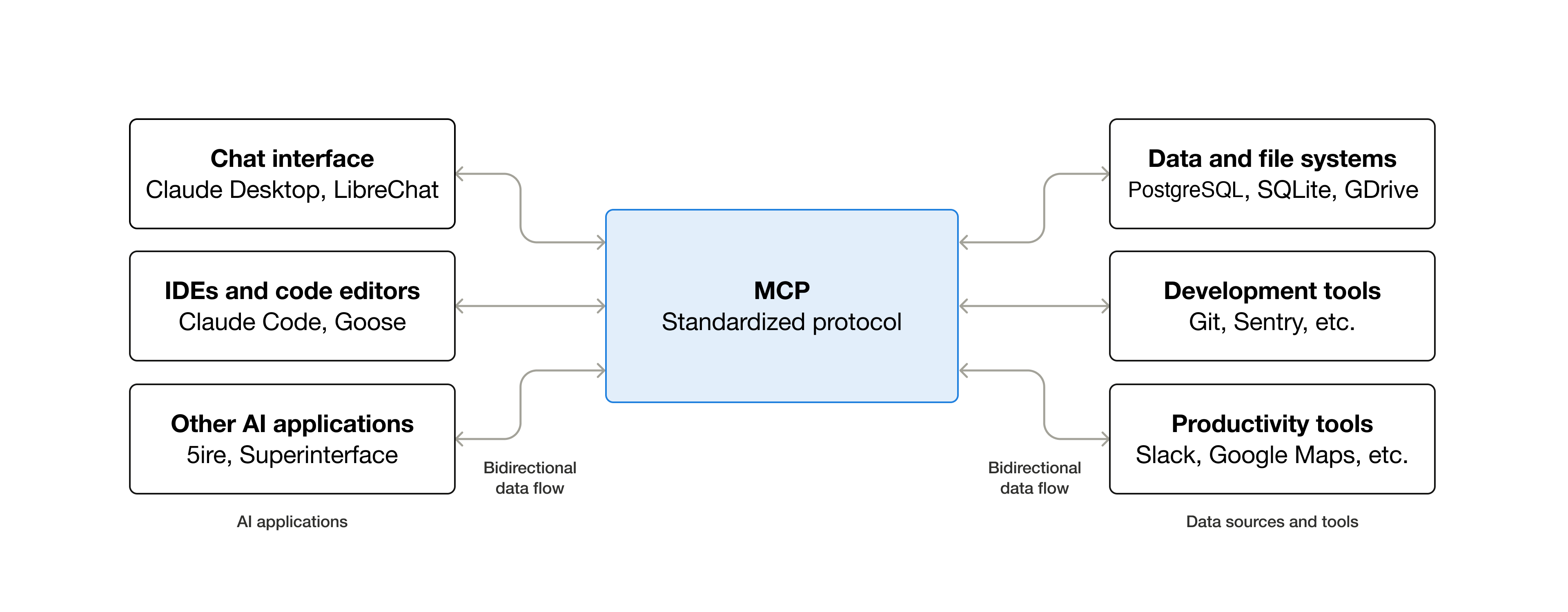 ## What can MCP enable?
* Agents can access your Google Calendar and Notion, acting as a more personalized AI assistant.
* Claude Code can generate an entire web app using a Figma design.
* Enterprise chatbots can connect to multiple databases across an organization, empowering users to analyze data using chat.
* AI models can create 3D designs on Blender and print them out using a 3D printer.
## Why does MCP matter?
Depending on where you sit in the ecosystem, MCP can have a range of benefits.
* **Developers**: MCP reduces development time and complexity when building, or integrating with, an AI application or agent.
* **AI applications or agents**: MCP gives them access to an ecosystem of data sources, tools and apps, which enhances their capabilities and improves the end-user experience.
* **End-users**: MCP results in more capable AI applications or agents that can access user data and take actions on the user’s behalf when necessary.
## Broad ecosystem support
MCP is an open protocol supported across a wide range of clients and servers. AI assistants like [Claude](https://claude.com/docs/connectors/building) and [ChatGPT](https://developers.openai.com/api/docs/mcp/), development tools like [Visual Studio Code](https://code.visualstudio.com/docs/copilot/chat/mcp-servers), [Cursor](https://cursor.com/docs/context/mcp), [MCPJam](https://docs.mcpjam.com/getting-started), and many others all support MCP — making it easy to build once and integrate everywhere.
## Start Building
Create MCP servers to expose your data and tools
Develop applications that connect to MCP servers
Build interactive apps that run inside AI clients
## Learn more
Learn the core concepts and architecture of MCP
Understand the security considerations and best practices for MCP
## Community
Learn how to get involved and contribute to MCP
- Twilio Ai MCP1 ItemLearn how to integrate Twilio MCP
Instructor

Free
Related Course
-
Global Communications in the browser
$4,000.00 Each app sells for 3,500+ this model took years to build, will take you hours in the day to create now.